Articles
Shelf-Ready Packaging Explained: What Retailers Expect and How to Show It
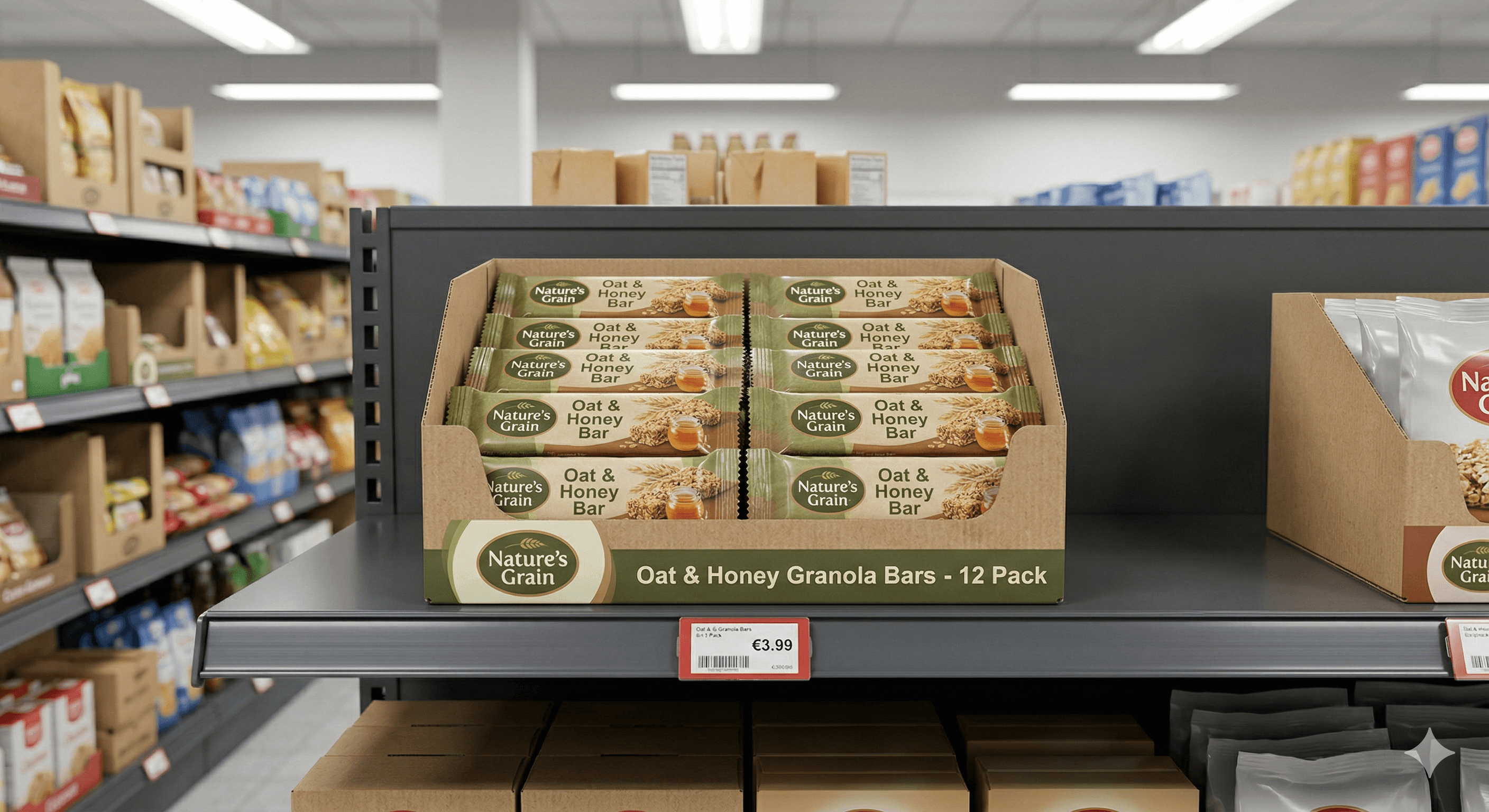
Walk into any major supermarket and look carefully at how products are displayed. In many cases, the products aren't sitting on the shelf individually — they're sitting inside a partially open box or tray that acts as both the shipping container and the display unit. That box is shelf-ready packaging, and for most major European retailers it isn't optional.
If you're an FMCG brand preparing to pitch to REWE, EDEKA, Lidl, or any other significant retailer, understanding SRP — and being able to show it convincingly — is one of the most practical things you can do before your first buyer meeting.
What shelf-ready packaging actually is
Shelf-ready packaging, sometimes called retail-ready packaging, is packaging designed to move directly from the delivery truck to the shelf with minimal handling. It typically arrives as a case or tray that can be opened and placed on the shelf as a single unit, with the individual products already arranged and facing the customer correctly.
The benefits for the retailer are significant. It reduces the time store staff spend stacking shelves, ensures consistent product presentation across all store locations, and minimises the risk of products being placed incorrectly. For busy retailers managing thousands of SKUs across hundreds of stores, SRP is a practical necessity rather than a preference.
What retailers actually look for in SRP
Not all shelf-ready packaging is created equal. Retailers evaluate SRP against a set of practical criteria that are sometimes called the five easies: easy to identify, easy to open, easy to shelf, easy to shop, and easy to dispose of.
Easy to identify means the case is clearly labelled so warehouse staff can find it quickly. Easy to open means it can be opened without tools in a single clean motion. Easy to shelf means it drops straight onto the shelf without adjustment. Easy to shop means customers can easily access and read individual products. Easy to dispose of means the empty tray can be collapsed and recycled without effort.
When a category buyer evaluates your SRP, they're running through these criteria — often unconsciously — based on what they can see. This is why your visual presentation of the SRP matters as much as the design itself.
The challenge of showing SRP before it exists
Here's the problem most FMCG brands run into. By the time you're pitching to a retailer, your shelf-ready packaging probably doesn't exist physically yet. You're pitching a concept, and you need to show it convincingly enough that the buyer can evaluate it as if it were already on their shelf.
A flat dieline or a technical drawing doesn't do this. A Photoshop mockup rarely captures the three-dimensional reality of how the tray looks when it's open and filled with product on a shelf. This is where a proper 3D rendering of your SRP becomes genuinely valuable — not as a marketing asset, but as a sales tool.
A photorealistic 3D rendering shows the open tray with products correctly placed inside, in a realistic shelf context, from the angles that matter to a buyer. It answers the question they're asking — what will this actually look like in my store? — before the physical packaging has been produced.
What a strong SRP rendering includes
A well-executed SRP rendering should show the tray from a front-facing shelf angle, with products correctly positioned and the tray partially open as it would appear in store. It should accurately reflect the packaging dimensions, material finish, and print design. And ideally it should be shown in a realistic retail environment — on a shelf, with appropriate lighting — so the buyer can genuinely picture it in their store.
Done well, this kind of visual transforms a pitch from a concept presentation into something that feels concrete and ready. That shift in perception matters enormously when a buyer is deciding which new products deserve a place in their next planogram review.
The practical takeaway
If you're preparing to pitch to a major retailer, make sure your SRP presentation goes beyond a flat design file. A photorealistic 3D rendering of your shelf-ready packaging — shown in context, accurately representing the final product — is one of the most persuasive tools you can bring to a buyer meeting. It shows that you understand how retail works, and that your product is genuinely ready for the shelf.